Lorenzo Ardeni/Projects/GamerKind

GAMERKIND

Every matchmaking tool filters gamers by what they play. None filter by how they behave. 9 out of 10 players I interviewed had experienced toxicity online - some, like me, quit games they loved because of it. GamerKind is a matchmaking app that puts behavior at the center, making good sportsmanship the thing that gets you matched.

ContextUX Master Project
RoleSolo - Full UX Process
Timeframe1 Week
Year2023
DeliverableHi-Fi Interactive Prototype
Solo Mobile App Gaming Matchmaking Reputation System
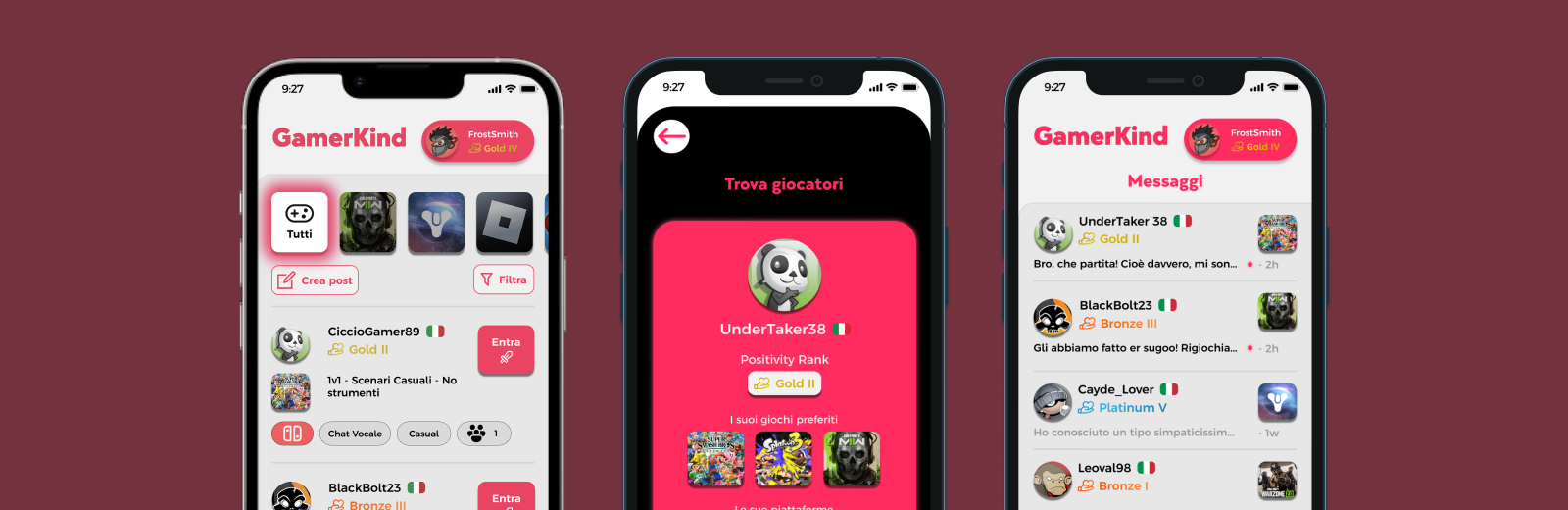
GamerKind app
// 01

Context

The brief from the UX Master was deliberately open: take a problem you genuinely care about, research it, and arrive at a working prototype in one week - ready to pitch.

I didn't have to look far for a problem. As a long-time player, I'd experienced gaming toxicity firsthand. With League of Legends in particular, it got bad enough that I walked away from a game I loved. That personal frustration became the starting point.

The question I wanted to answer: what if finding good people to play with was as easy as a swipe - and what if the system actively rewarded being a decent human being?

Full ownership, one week. Solo project from problem definition to hi-fi prototype. Research, synthesis, concept, user flows, visual design, and an interactive prototype - all compressed into a single intense week. The constraint forced sharp prioritisation: every decision had to earn its place.

// The Challenge

One Week, End to End

From a blank page to a pitchable prototype in seven days. No room for wasted exploration - research had to translate into decisions fast.

A Real, Personal Problem

The brief demanded authenticity. Toxicity in gaming wasn't an abstract topic - it was something I'd lived and could speak to honestly.

Concept Over Polish

With limited time, the priority was proving the idea worked conceptually - a strong, defensible core mechanic over pixel-perfect screens.

// 02

The Problem

Two problems surfaced in research, and they were tangled together. The first: it's genuinely hard to find the right people to play with - people on your platform, playing your games, on your schedule. The second, and more painful: even when you do find people, online gaming is full of toxic behavior.

The interviews made the priority clear. The matchmaking problem was real, but toxicity was the wound. People weren't just frustrated they couldn't find teammates - they were exhausted by the ones they did find. The deeper need wasn't "find me anyone." It was "find me someone who won't ruin my evening."

Existing tools missed this entirely. They match on game and platform - never on the one thing that actually determines whether a session is fun: the person on the other end.

// Two problems, one priority
01

Finding the right people - matching by game, platform, and availability is fragmented across tools that don't talk to each other

02

Toxic playersPrimary
Even good matches turn sour. No existing tool filters or accounts for how people actually behave in-game

The reframe: GamerKind isn't really a matchmaking app. It's a reputation app that happens to do matchmaking. Behavior is the product.

// 03

Research

01

User Interviews

10 structured interviews with gamers - recruited from my own network, social media followers, and a LinkedIn callout. A notable share were League of Legends players, which later shaped a key design decision.

02

Survey

An 18-question survey distributed to 30 respondents, quantifying the qualitative signals from interviews - frequency of toxic experiences, attitudes toward community, and matchmaking habits.

03

Competitive Analysis

Desk research on how players currently find each other: Discord, in-platform LFG systems, and gaming groups on Reddit and Facebook. The common gap became the opportunity.

9/10

had experienced toxic behavior while playing online - making it nearly universal, not an edge case

7/10

believed a positive community would meaningfully improve their gaming experience

// What the research told me

Insight 01

Toxicity is the default, not the exception

At 9 out of 10, bad behavior isn't something that occasionally happens - it's the ambient condition of online play. Any solution had to treat it as the central problem, not a feature to bolt on.

Insight 02

People want community, not just teammates

7 out of 10 saw positive community as a real improvement to their experience. The appetite for something better was already there - the market just hadn't offered it.

Insight 03

Competitive players already think in ranks

A large share of interviewees played League of Legends. They already understood and trusted rank-based progression. Building reputation as a familiar ranked ladder meant zero learning curve for a huge segment of the audience.

Insight 04

Existing tools solve the wrong half

Discord, LFG systems, and gaming groups all help you find people - none help you find good people. They match on game and platform, never on behavior. That gap was the whole opportunity.

// 04

Design Decisions

The core challenge was making a reputation system feel natural, not bureaucratic. Every decision aimed to borrow mechanics players already knew - from dating apps, from competitive gaming - so the app felt instantly familiar.

01

Tinder-style swipe matching

People my age already understand Tinder, and its swipe mechanic naturally echoes gaming interactions - quick, binary, low-commitment decisions. Using a familiar matching metaphor meant users could start finding players without any tutorial. The interaction was already in their muscle memory.

Interaction model
02

Positivity Rank, inspired by League of Legends

The reputation system is structured as a ranked ladder - Silver, Gold, Platinum - directly inspired by League of Legends, which a large share of my interviewees played. Borrowing a ranking system they already trusted meant the concept of "earning reputation" needed no explanation. They got it instantly because they'd lived it.

Core mechanic
03

Asymmetric XP - giving and receiving

Leaving a positive rating earns 50 XP; receiving one earns 100 XP. The balance is deliberate: receiving recognition should weigh more, since it reflects how others experienced you - the truest signal of good behavior. But giving still rewards participation, keeping the whole rating economy active. The numbers tie back to each action's impact on the global ranking system.

Reward economy
04

Paste-your-ID messaging

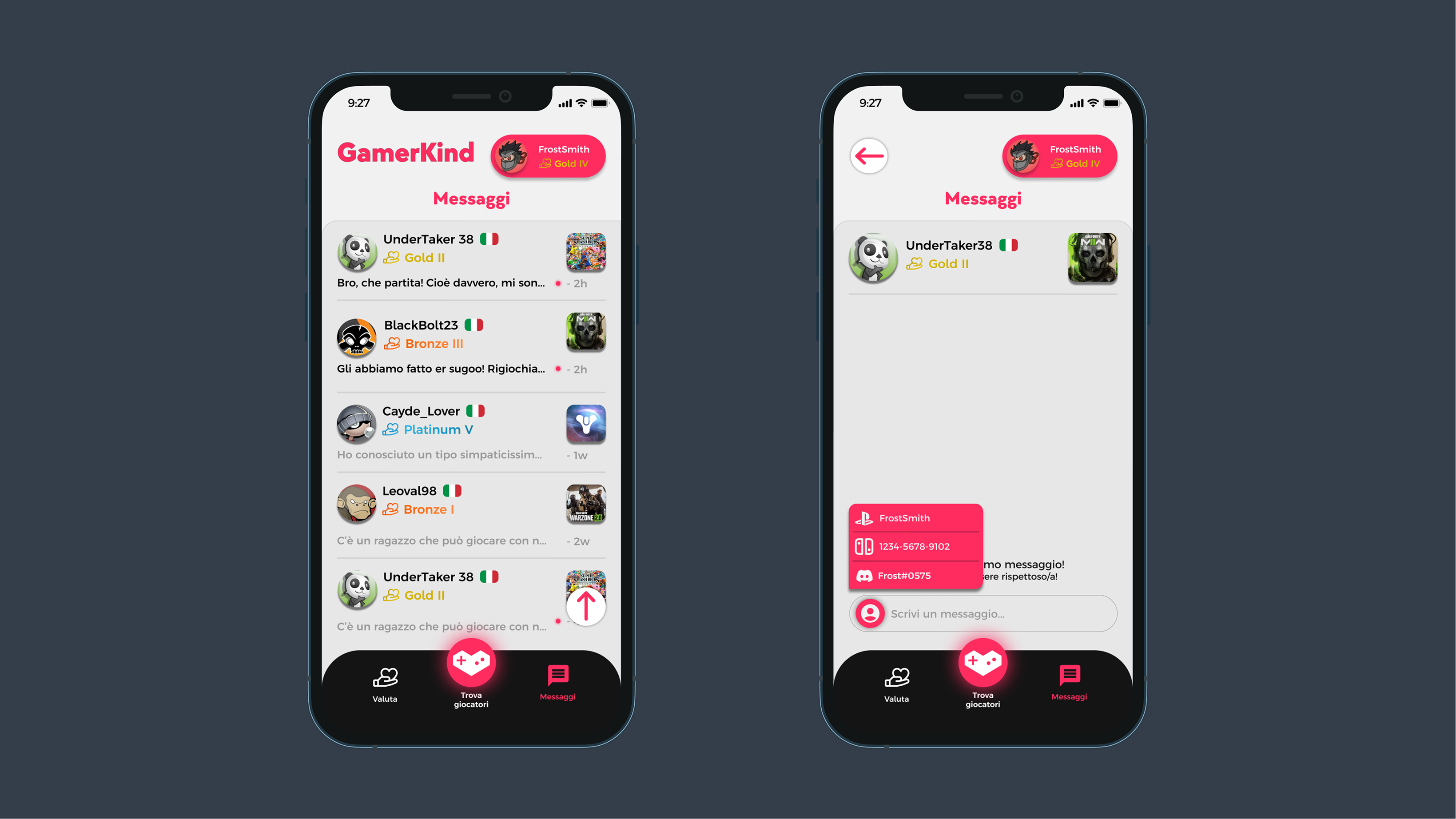
In chat, users can instantly paste their gaming ID - PSN, Xbox gamertag, Nintendo friend code, or Discord username - as a ready-to-share message. It removes the most tedious friction in making a new gaming friend: the awkward "what's your username" exchange. One tap, and you're connected on the platform that matters.

Friction removal
05

Cut the per-game groups feature

An early version had dedicated groups for every game and every activity. In practice this created an overwhelming sprawl of information - users would have drowned in channels and sub-channels before finding anyone. I removed it. The cost to clarity wasn't worth the feature. Focus beat completeness.

Removed feature
// 05

The Solution

GamerKind turns reputation into a game of its own. The more positively you play, the higher you rank, the better the people you get matched with. Good behavior becomes its own reward loop.

The Positivity Rank

A reputation ladder borrowed from competitive gaming. Climb it by being someone people want to play with.

Entry tier

Silver

Where everyone starts. New players build their reputation from here, one positive interaction at a time.

Established

Gold

A proven track record. Gold players are consistently rated well and get prioritised in better matches.

Top tier

Platinum

The community's best. Platinum is a signal of trust - the people everyone wants on their team.

+50 XP

For leaving a positive rating

Rewards participation and keeps the rating economy alive. Acknowledging good players is itself a positive act.

+100 XP

For receiving a positive rating

Weighted higher because it reflects how others experienced you - the most honest signal of good sportsmanship.

Onboarding

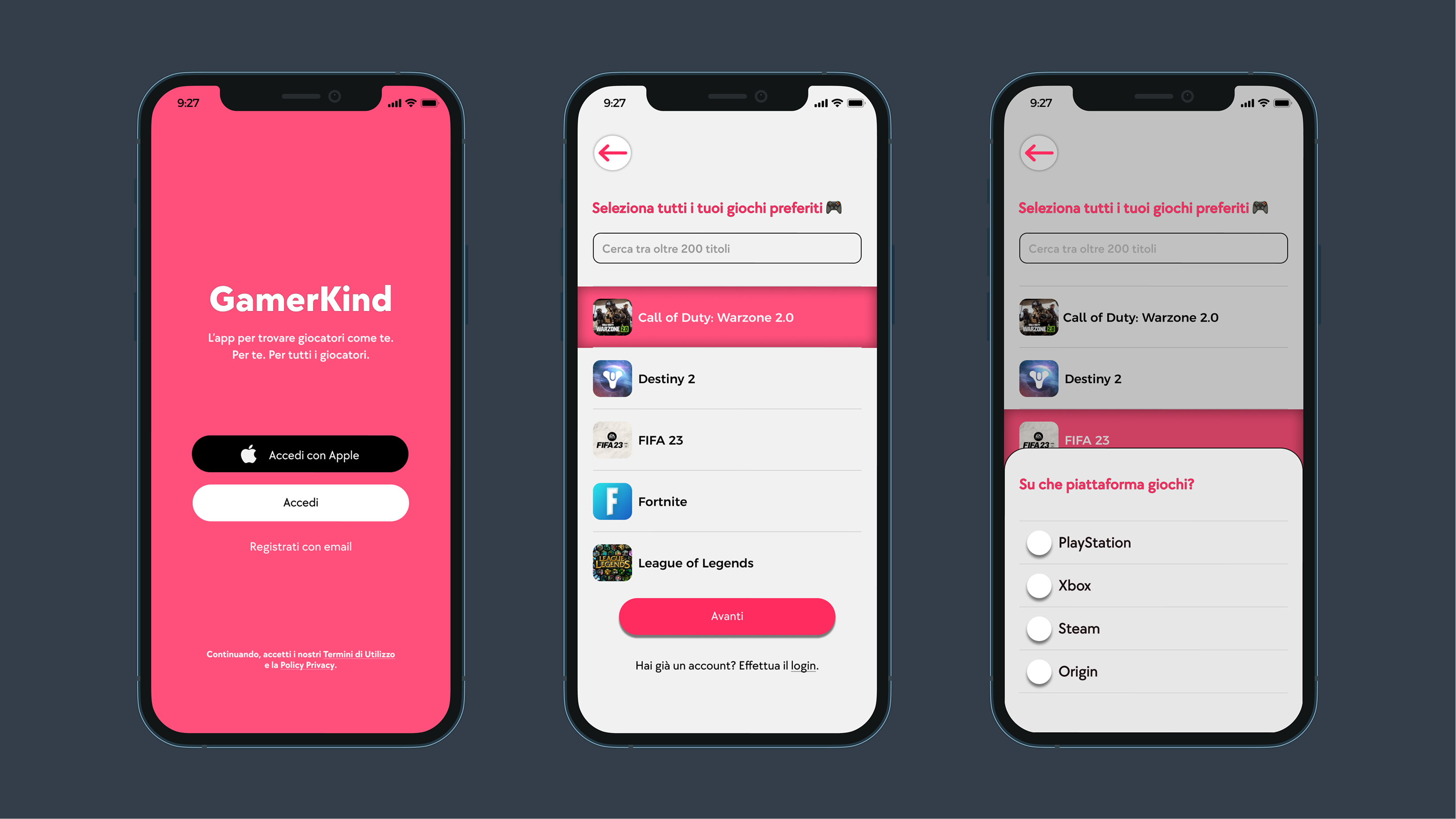
The first thing you do is pick the games you love. Seeing your favorite titles light up immediately makes the app feel like home - it understands you before you've done anything else.

GamerKind - Onboarding
Matching

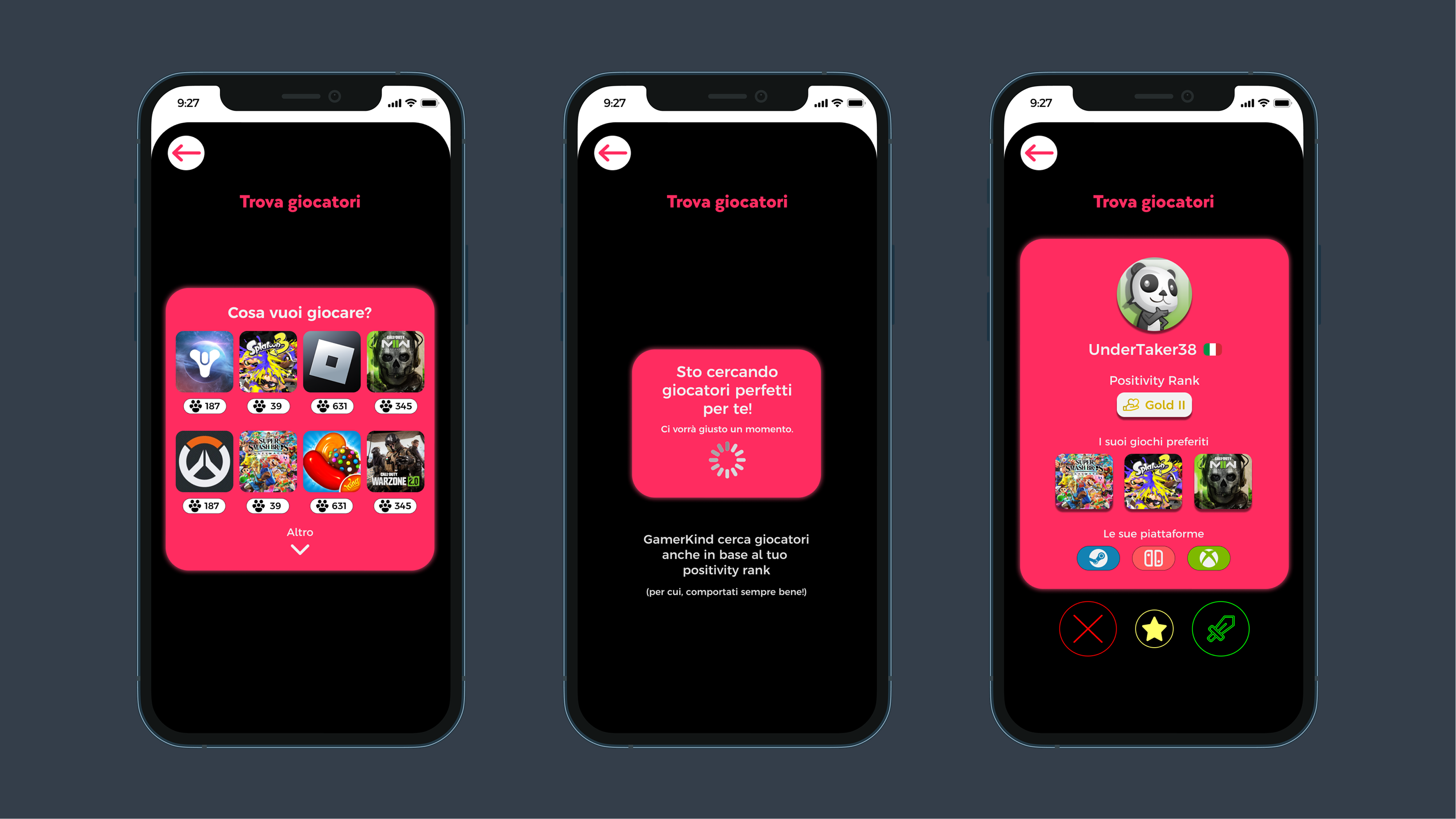
Swipe through potential teammates filtered by game, platform, and Positivity Rank. Each profile leads with the things that matter: what they play, where, and how well they treat other players.

GamerKind - Matching
Positivity Rank & Chat

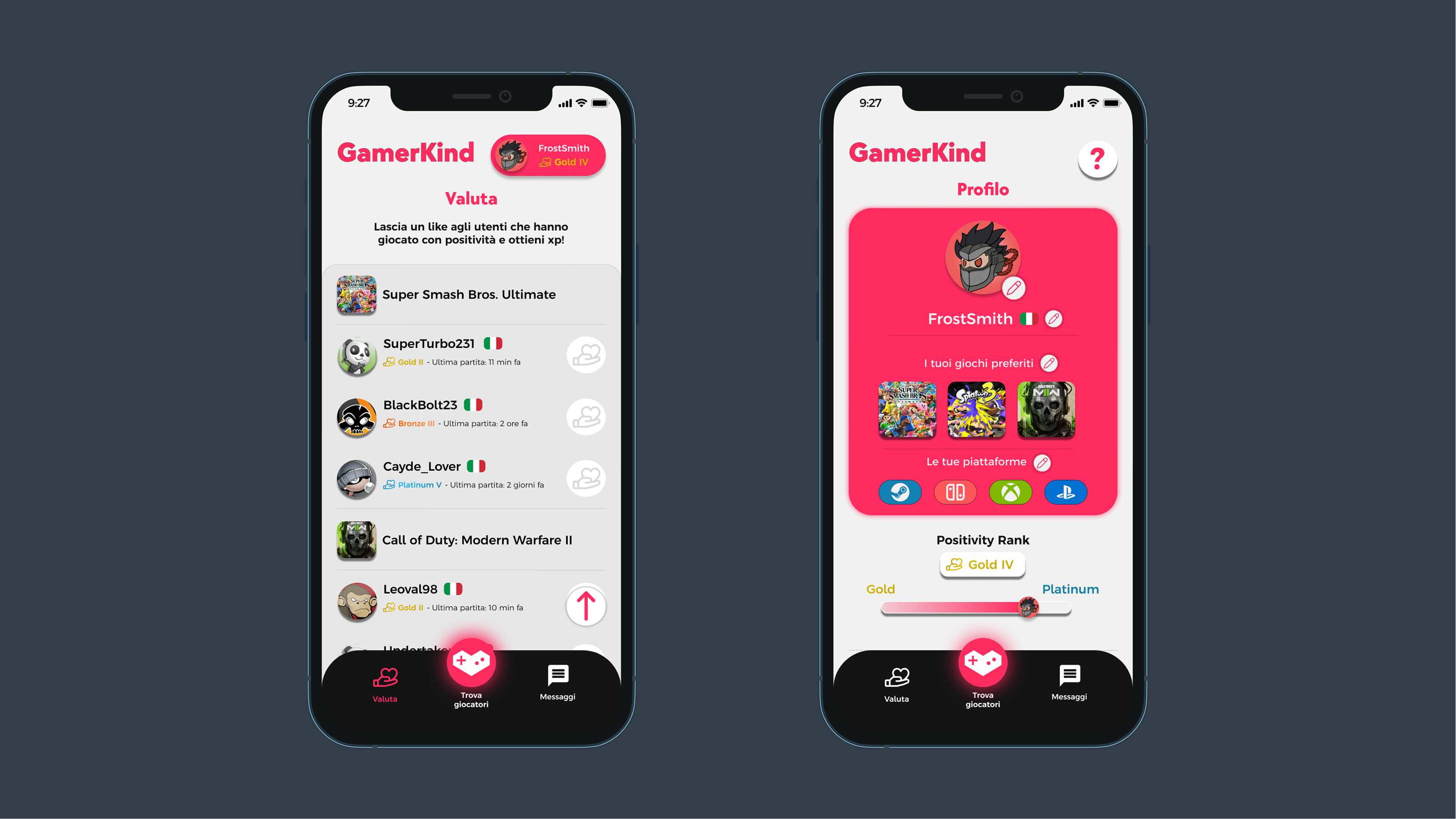
Left: the rank profile, showing your tier and progress toward the next one. Right: the chat, where pasting your gaming ID (PSN, Xbox, Nintendo, Discord) is a single tap - turning a match into a real connection instantly.

GamerKind - Positivity Rank
GamerKind - Chat with ID paste
// 06

Validation & Feedback

Feedback gathered during the interviews showed strong resonance with the core idea - and surfaced one sharp, important concern that I'd carry forward.

Positive signal

"This is exactly what I've been missing - a way to find people who actually want to have a good time."

Interview participant
Positive signal

"The rank system makes sense immediately. It's like League, but for being a good person."

Interview participant
The critical one

"I'm not sure how reliable the ratings would actually be - couldn't people just game the system?"

Interview participant
// The reliability problem - and how I'd solve it

That last comment was the most valuable piece of feedback I got. At the time, I hadn't designed an answer for it - the prototype assumed ratings were given in good faith. But a reputation system is only as strong as its resistance to manipulation.

Here's the mechanism I'd build: the system cross-references a user's rank against the volume of reports they receive. If someone holds a high Positivity Rank but is also accumulating reports for bad behavior, that contradiction triggers a review - and the rank is adjusted downward accordingly. Reputation you can't simply farm. It has to survive scrutiny. This is the kind of systems-level thinking I'd put at the center if I built GamerKind for real.

// 07

Reflection

// What I'd do differently

A much stronger UI - the visual layer is where the one-week constraint shows most. Beyond polish, I'd design session-specific lobbies: raids, particular game modes, time-limited events. Matching people for a one-off raid is a different problem from matching them as long-term teammates, and the app could be smarter about that distinction. And I'd think harder about the flows and dynamics - especially the anti-manipulation logic the reliability question exposed.

// What I'm proud of

The onboarding and the paste-your-ID chat feature. The onboarding makes you feel at home the moment you see your games light up - it earns trust before asking for anything. And the ID-paste detail removes the single most annoying friction in making a new gaming friend. Both are small, human touches that came from actually understanding how players think. That's the part of the work I care about most.

← Previous VIK Teacher Dashboard